Construction linked with banks failed due to loss of credit and bankruptcy, leading to the building of Hoovervilles. Shanty houses were the usual living place for most Americans during the Great Depression. Hoovervilles is a more common name. Jobless people relied on the kind deeds of others for basic necessities such as milk and bread. Hoover believed that it was the job of good citizens to help the poor, not the government's. Soup kitchen's were the main dining place for Americans. The middle class was non existent, ranging from the extrememly poor to the extrememly rich. A man's day conisted of searching for a job, and when the search ended with no results, he felt it as a personal failure for his joblessness. Women even went on the hunt for jobs, despite how they were viewed. People had to sell usually expensive goods for significant less amounts. Even families' children were needed for labor. Miniorities, such as African Americans were negatively impacted even more so than whites. White men demanded that African Americans were forced out of their jobs untill, "every white man had a job". In such an economic depression, entertainment was valued. Radio and movie theaters provided a source of relief after a long day of hardships. Entertainment was the only enjoyable thing for people of the Great Depression.
Monday, February 23, 2009
Life in the Great Depression
Construction linked with banks failed due to loss of credit and bankruptcy, leading to the building of Hoovervilles. Shanty houses were the usual living place for most Americans during the Great Depression. Hoovervilles is a more common name. Jobless people relied on the kind deeds of others for basic necessities such as milk and bread. Hoover believed that it was the job of good citizens to help the poor, not the government's. Soup kitchen's were the main dining place for Americans. The middle class was non existent, ranging from the extrememly poor to the extrememly rich. A man's day conisted of searching for a job, and when the search ended with no results, he felt it as a personal failure for his joblessness. Women even went on the hunt for jobs, despite how they were viewed. People had to sell usually expensive goods for significant less amounts. Even families' children were needed for labor. Miniorities, such as African Americans were negatively impacted even more so than whites. White men demanded that African Americans were forced out of their jobs untill, "every white man had a job". In such an economic depression, entertainment was valued. Radio and movie theaters provided a source of relief after a long day of hardships. Entertainment was the only enjoyable thing for people of the Great Depression.
Credit in the Great Depression
The Great Depression's most impactful cause was that of credit. In the roaring 20's money was not used to pay for things. Credit was. When it came time to pay for products obtained through credit, the people could not. This lead to a national debt, as banks ran out of money. Banks had given out risky loans based on credit. When people could not pay back these loans, banks were forced to decalre bankruptcy. When news of banks closing and not having enough money spred, a nation wide panic occured, where people quickly tried to withdraw everything in their savings account. When banks could not give everyone their money, due to extreme withdraws of other members, people were left with nothing. Credit was over used in the 20's leading to the depression through the 30's. Such credit failures are still present today. Banks in the 21st century have given out risky loans to people who can not pay back the credit they have recieved. This is proven in the housing market and increasing forclosure. Credit still impacts the economy now, as it had eighty years ago. The nation is still in debt as a whole, and will be as long as their is credit.
Sunday, February 1, 2009
Carnegie Hall
Carnegie was an immigrant from Scotland, immigrating to America as a child. He was the builder of Pittsburgh's Carnegie Steel Company. With the excessive money he made from his steel businesses he founded educational ventures, such as Carnegie Endowment for International Peace and Carnegie Mellon University. Carnegie could have ran for Ms. America, considering how he donated most of his money to countries of the world, schools and libraries. As well as the steel industry, Carnegie had investments in the railroad system. The Sherman Antitrust did not really effect Carnegie, thus giving him the title of one of the richest men on Earth. He, however, did not get the bad reputation of most monopolistic men, as he donated much of what he earned.
Friday, January 30, 2009
Progressivism, yo.
The government fought against monopolies by trying to destory trusts. William H. Taft, also known as the "trustbuster", wanted to destory all monopolies. This encluded monopolies on the train transportation system. Tycoons over the railroad were able to control the price of shipping, manipulating how much farmers had to pay to ship their goods. Farmers lost massive profits during this, making many of them have to resosrt to sharecropping. Regulating monopolies was essiential to keep the middle and lower class, or anyone not envolved in monopolies, from encountering massive debt. My regulating monopolies, Taft was truly controlling how well the country would progress. However, the Panic of 1907 occured, deeming his attempts slightly unsuccessful. Woodrow Wilson wanted to expand "The New Freedom", or expand democracy. He enchanced democracy, rather than change it to something new. Roosevelt's attempt to pereserve the land, yet make cheaper engery sources was somewhat successful, as dams currently reside to do so, yet perserving the land in some of these efforts were not.
So, in all, the three leaders of Progressivism were mostly not successful, but they did have some impact on the progress of America.
Sunday, December 7, 2008
Back to the Cowhands
Back to the Future III is the ultimate example of the West romanticized. Gun draws in the streets, bandits, broads in distress, train hijackers, and Indians highlight the most romanticized infulences of the west. But such adventure was not available. Fights between Indians were not as heroic as depicted, as hundred of whites were massacred and scalped. Cowboys had a less adventurous tale, as herding cows did not have as many heroic tales in the job description, as depicted by the east coast..
Sunday, November 16, 2008
Saturday, November 8, 2008
Education is Changing
Public schools became a growing fad as America had a want for better schools to educate their children with. They were truly created for middle class. Though women attended school, they were taught how to sow and be good mothers, rather than learn things such as arithmetic. Women were taught how to become proper wives, while men were taught tools of trade. Men of higher class were taught how to progress in careers such as doctors or lawyers, while the poor were taught things of industrial manner. African Americans education was not furthered as it was illegal to do so in the south, and they were not allowed into the schools in the north. This progress helped select people, mostly the middle class and up. Poorer people rarely attended school, as it was not required and their help was needed on the family farm. Because not all children were educated, and they were not generally educated the same, but for specific areas, this reform was somewhat lacking. It was not a fair system, but at least education was expanding.
Saturday, November 1, 2008
Whites used faulty reasons to defend their use of slavery, which was not really necessary due to the condition of some of their fellow whites whom could have used the jobs themselves.
Truly, the South were cheap, morally deprived people. The abrupt ending of slavery after the civil war proves that slavery was not necessarily needed.
Friday, October 17, 2008
Jackson Conspiracy
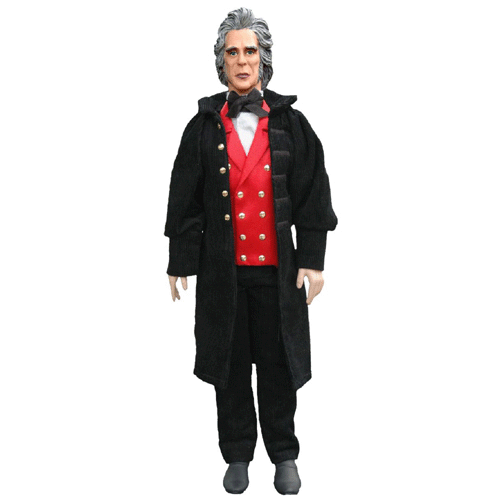
King Andrew was called so due to his abuse of power. Above abusing power, he also wanted to extend the powers of a President. The Whig party feared that his increased power would lead to a king-like rule, thwarting all they had done to win independence. Andrew Jackson continued his plans with the expulsion of the Indians, despite Congress' intrusion on the plans, declaring it "unconstiontitutonal". This defiance of Congress built on his "king" title. His prejudice against banks was a fault, as well. The absorption of power from the National Bank made Jackson appear as if he was taking the power in exchange. More power, means more king like.
The nullification crisis also created a King like essence to Jackson. The dislike for tariffs or imported goods was enough for the South to even try to make themselves separate from the United States as a whole. Taxes always related back to a "king", such as during the American Revolution. Considering, the King's taxes are what brought Americans overboard at that time, it was a great blow to what the South demanded. Though there was taxation with representation, the South would not settle for such terms, and deemed Andrew Jackson as King Andrew.
Sunday, October 12, 2008
Coexistence?
"How could both Sectionalism and Nationalism exist at the same time and at the same place?"
Sectionalism and Nationalism can coexsist in the same place just like how an Arabic person can reside in the States.
Everyone is "yaay for equal rights!", yet people demand that someone wearing a turban in the airport should be throughly checked for explosives.
They are contradicting terms, yet they were team players during The Era of Good Times.
While the south encouraged the use of slavery so that its economy could still thrive, other states began to become "free states". which spurred the south's need to become sectionalist. If they could diverse themselves from the rest of the country, they could continue to have slave labor.
Despite wanting to have slaves, the south also wanted to be involved in nationalism. The wanted the benefits of having a government not impaired by other world powers.
This sense of nationalism increased after the War of 1812. The sense of being an American enforced the want of nationalism.
Sectionalism and Nationalism can coexsist in the same place just like how an Arabic person can reside in the States.
Everyone is "yaay for equal rights!", yet people demand that someone wearing a turban in the airport should be throughly checked for explosives.
They are contradicting terms, yet they were team players during The Era of Good Times.
While the south encouraged the use of slavery so that its economy could still thrive, other states began to become "free states". which spurred the south's need to become sectionalist. If they could diverse themselves from the rest of the country, they could continue to have slave labor.
Despite wanting to have slaves, the south also wanted to be involved in nationalism. The wanted the benefits of having a government not impaired by other world powers.
This sense of nationalism increased after the War of 1812. The sense of being an American enforced the want of nationalism.
Subscribe to:
Posts (Atom)